

21 April – 26 June 2026

Written by: Tigran Keryan, BOKU
Read also in:

How can planning education better prepare future planners to address climate change, biodiversity loss, and sustainability transformations?
This question was at the centre of the workshop “Future of Planning Education”, organised by the BOKU ᴇNᴀBʟS team with support from 3s and in cooperation with the Austrian Society for Landscape Architecture (ÖGLA), held on 29 April 2026 at BOKU University in Vienna.
The interactive workshop brought together participants from research, education, planning practice, and public administration, including representatives from the City of Vienna, planning offices, local authorities (including a mayor), decision-makers, and higher and vocational education and training (TVET) institutions. The aim was to reflect on the implementation of Nature-based Solutions (NBS) and biodiversity-oriented approaches in real-world contexts. Through collaborative exercises and discussions, participants explored which framework conditions, resources, governance structures, and value systems enable or hinder successful NBS implementation.

Drawing on concrete examples from participants’ own projects, the workshop addressed key challenges, opportunities, and governance processes for NBS planning in practice. At the same time, successful approaches, enabling factors, and lessons learned were shared and discussed across different spatial and institutional contexts. A central focus of the workshop was the question of competencies and skills needed by future planners to support green transitions and climate- and biodiversity-positive development. Through a collaborative persona exercise, participants reflected on which capacities are already covered in current planning curricula and where important gaps remain.
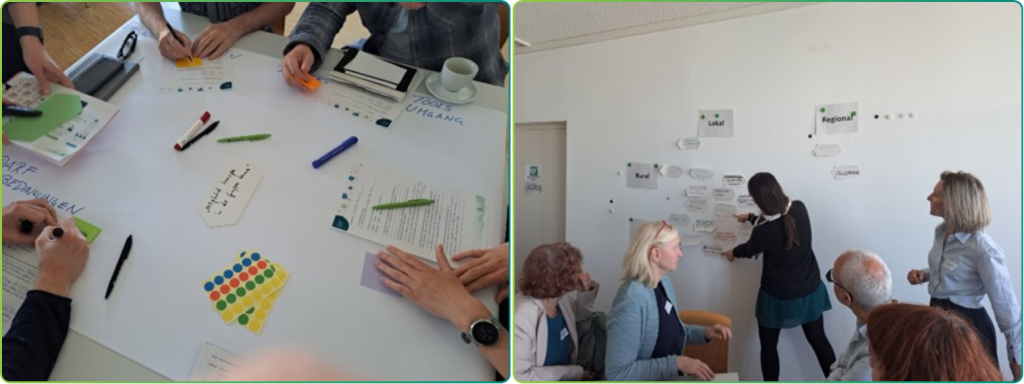
The policy workshop revealed that:
The event concluded with an exploration of the BOKU Core Facility dedicated to spatial and landscape-related research and decision support and supporting the Austrian Living Lab activities. Participants were introduced to how digital tools and immersive technologies, including GIS-based spatial analysis, drone mapping, AR/VR visualisation, real-time simulation environments, and interactive landscape modelling, can support the design and co-creation of Nature-based Solutions and biodiversity-sensitive planning in teaching and research. The presentation highlighted how these tools enable more participatory and evidence-based decision-making by supporting researchers, planners, policymakers, and communities in visualising landscape transformations and assessing environmental scenarios in accessible, collaborative ways.

The workshop outcomes will inform both policy and education development by supporting recommendations for integrating NBS and biodiversity into practice-oriented teaching and research in higher education and by contributing to a teaching guidebook that helps educators equip graduates with the skills needed for sustainability-oriented planning practice.


21 April – 26 June 2026
28 June 2026