

27 November 2025
Written by: Anželika Dautartė, VMU
Read also in:

Synergy of Nature-Based Projects in Dzūkija: Living Labs as Catalysts for Community Engagement
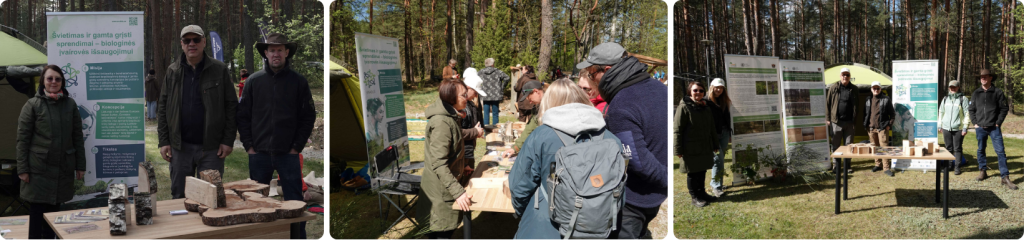
On 26-27 April 2025, the Dzukija National Park hosted the festival “Vidur girių” dedicated to the 50th anniversary of the Čepkeliai State Nature Reserve. The event brought together around 300 nature enthusiasts, educators, researchers, and active citizens. Among the participants was the team from Vytautas Magnus University’s Faculty of Forest Sciences and Ecology, who set up an educational tent showcasing the convergence of three interrelated environmental projects.
The VMU team’s presentations highlighted the synergy of several international and national projects, all aiming to develop, strengthen, and disseminate Nature-Based Solutions (NBS) by involving local communities and educational systems.
Central focus was given to the ᴇNᴀBʟS project, which seeks to empower society to act for biodiversity through education, hands-on experiences, and local initiatives. The project strengthens the connections between universities, schools, and communities, relying on the methodology of living labs—open spaces where conservation ideas are not only discussed but also practically tested through collaboration among various stakeholders.
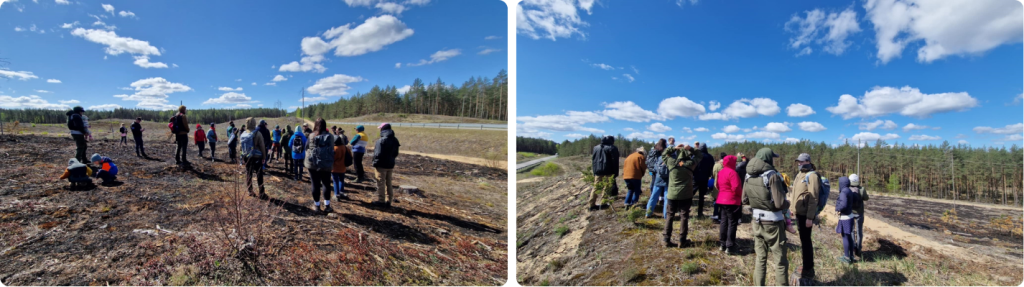
This methodology was also presented as an effective tool for collaboration and reflection in two other projects. The LIFE Integrated Project “Optimizing the Management of the Natura 2000 Network in Lithuania (NATURALIT)” introduced visitors to nature-based forest management, such as controlled understory burning, which helps restore habitats and preserve rare species by leveraging natural processes.
Meanwhile, the third project presented—” Ecosystem-based Adaptation and Changemaking to Shape, Protect and Maintain the Resilience of Tomorrow’s Forests (eco2adapt)”—encouraged discussions about forest adaptation to climate change, the impact of large herbivores on ecosystems, and the role of society in shaping a more sustainable forest future.
The common denominator of all these projects is not only the integration of natural sciences and practice but also the empowerment of society. Visitors were invited to identify invasive species using the Pl@ntNet app, participate in ecological quizzes, and make symbolic pledges to nature. It was emphasised that nature conservation is not solely the concern of specialists—it is the responsibility and right of all of us to act. During the festival, the living labs approach emerged as a key to participation: promoting co-creation, open dialogue, and the opportunity to address ecological challenges not “for” communities but “with” them. The synergy of projects not only complemented each other but also created a space to experience how NBS arise from shared experiences, collective responsibility, and a common vision.


27 November 2025
10 November 2025